← All projects
Building now
AI infrastructure · CRM
Built inside IntiGo
2026

Argus

The company's brain — an always-on AI operator system, grounded in production data, supervised by humans.

I'm a developer at IntiGo — a mid-sized logistics business: ~100 vehicles, 275 drivers, hundreds of merchants shipping parcels through us every day. Argus is the AI operator system I'm building to run the business the way a CEO uses specialist staff — except the staff are AI agents grounded in our actual production database, and the human supervising them is me.

Written by , senior full-stack engineer in Tunis. LinkedIn · GitHub

Claude API (Anthropic)OpenAI APIGemma 4 (local · Mac mini)Qwen2.5:14b (local · Ollama)LLM ApplicationsAgentic AIAI AgentsLLM AgentsMCPTool CallingFunction CallingPrompt EngineeringContext EngineeringStructured OutputsMemory SystemsHuman-in-the-LoopRAGVector SearchEmbeddingsLLM EvalsAI WorkflowsAI AutomationModel Routingn8nNode.js / TypeScriptPostgreSQL (read-only replica)GitHub ActionsSlack APIMeta APIMac mini · on-prem

“What if the company itself had a mind?”

The idea, in one paragraph

A network of specialist AI agents — each one good at one thing — connected through a shared backbone, all reading from the same production (read-only) replica database, all logging every decision they make. Claude is the decision-maker. Agents handle routine work autonomously. Anything ambiguous, sensitive, or high-stakes escalates to a human through Slack and email.

Over time the system earns more autonomy in categories where its track record is clean, and stays cautious where it's not. Less AI assistant, more AI workforce that runs the business while everyone sleeps and shows the receipts every morning.

Why this is possible now, but wasn’t two years ago

Three things changed. First, the models got good enough — Claude can read an email, look up an order in a database, and write a reply better than most staff under time pressure. That wasn’t true in 2023.

Second, the plumbing got cheap. n8n, Postgres, a Mac mini under a desk, the Claude API — the entire stack costs less than one mid-level salary per year.

Third, the grounding problem is solvable. This is the one nobody talks about enough.

The grounding principle — the agent never makes up a fact

Most 'AI employee' products I've seen advertised fake the hardest part. They ingest documents, do some RAG magic, and hope the model says something sensible. That doesn't work in operations.

If a customer asks 'where is my parcel' and the AI invents a tracking number, the company loses the customer. If it quotes a wrong price, the company loses money. If it commits to a delivery date that doesn't exist, the company loses trust — and trust is the actual product in logistics.

Before composing any customer-facing reply, the agent must call a read tool against our production database. The reply is built from what comes back. If the lookup returns nothing — unknown order, no matching client, missing record — the agent doesn't guess. It drafts and escalates. Unsexy plumbing work. Also the entire game.

Module 1 — Email triage agent

Watches the company inbox in near real time. For every incoming email, Claude reads it and chooses one of four actions: do nothing (newsletters, receipts, automated notifications), respond (draft a reply), notify (ping a human on Slack and email because someone needs to act), or escalate (the agent isn't sure — kick it upstairs).

Every decision logged. Every latency tracked. Every token counted. The non-negotiable rule: auto-send is disabled at launch. Every reply is a draft a human approves, until override rates prove the agent safe in a given category. Then, and only then, it earns the right to send on its own.

Module 2 — Social media operator

Same architecture, applied to Facebook first (Instagram and WhatsApp later — they share the Meta API). Replies to comments. Answers Messenger DMs. Publishes posts from a human-approved calendar.

Every reply is grounded in real data. Customer comments 'where is my parcel?' — the agent looks up the actual shipment and answers with the actual status. Customer asks for a quote — the agent pulls real pricing. Customer asks about a refund — the agent doesn't touch it; it drafts for human review.

Public channels mean public mistakes, so the autonomy bar starts higher than email. Only the safest, most repetitive intents auto-reply. Everything emotional, legal, complaint-shaped, or unfamiliar drafts for human review.

Module 3 — Member directory & outbound conversation engine

The first two modules listened. Module 3 talks — at scale. A directory layer over the intigo_finance database lets the LLM resolve the right person from across thousands of members (1,000+ drivers, merchants and partners), open a two-way conversation on the right channel (email, WhatsApp, SMS), and ground every outbound message in actual operational data: 'Where is parcel COL-4821 that you're carrying?' is built from a live lookup, not a guess.

When the recipient replies, the agent reads the reply against the same grounded context and decides the next step — close the loop, draft a follow-up, or trigger an action. Any action with real-world consequences routes back through Argus's existing trust gate: draft for human approval first, autonomous send only once the override rate proves the agent safe in that category.

Module 4 — Internal CRM, locally powered

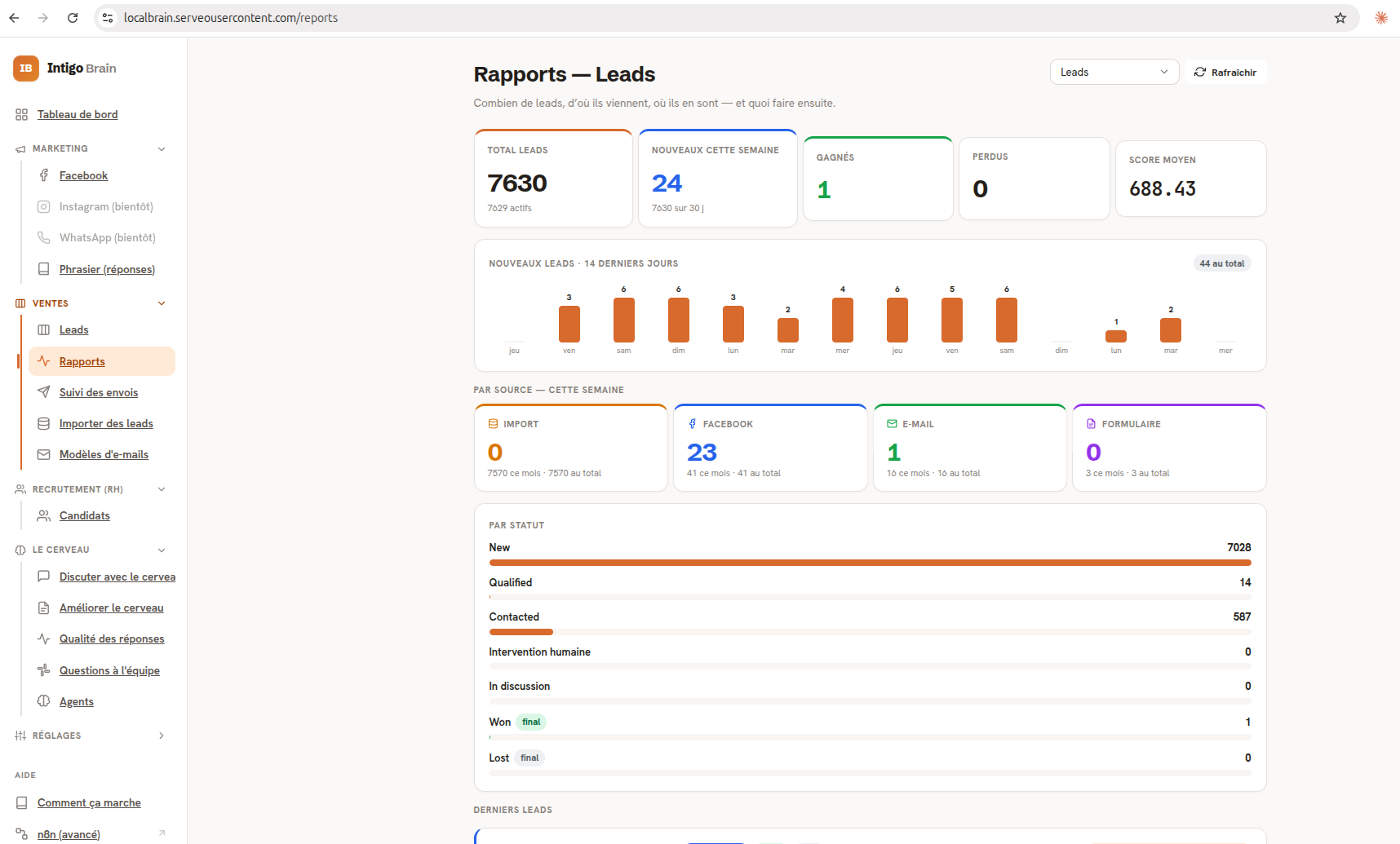
Argus needs an internal cockpit, not just outbound channels. Module 4 is the CRM surface on top of the brain: leads, sales pipelines (New → Qualified → Meeting Scheduled → Proposal Sent → Won/Lost), marketing automations, HR — and, later, support. Same grounding rule: every action — assign a lead, send an email sequence, move a stage, schedule a reminder — is built from a live read against intigo_finance, and every consequential action still routes through Argus's existing trust gate.

The decision layer here runs on a local Gemma 4 on a Mac mini under the desk, not the cloud, for three reasons. The workloads are routine enough that Gemma is good enough; HR and lead data are sensitive and never leave the building; and at IntiGo's volume, local inference costs €0 per call. Claude (cloud) and Gemma (local) split by workload — Claude for the hard reasoning and customer-facing replies, Gemma for the high-volume routine CRM work and anything privacy-sensitive.

The architecture

A hybrid stack, because nobody has solved this with a single tool. n8n on both sides — pulling the world in (webhooks, databases, APIs, email, schedules) and pushing decisions out (replies, alerts, database writes, API calls, published content). The AI in the middle is the brain that decides what to do.

A Node.js / TypeScript service handles the decision logic — the Claude calls, the guardrails, the database writes. Postgres is the truth layer: every event, every decision, every action, every metric. Audit trail and dashboard source in one place.

MCP is the backbone protocol so new tools can be added without rewriting agents. GitHub-backed everything so the system is portable — develop on a PC, production runs on a Mac mini, secrets stay out of the repo, the whole thing reconstructs in twenty minutes on any machine.

The gap in the market

Agent orchestration frameworks (LangGraph, CrewAI, AutoGen) are flexible — you build everything yourself. 'AI employee' SaaS products (Lindy, Relevance AI, Cognosys) are pre-baked and generic — they can't ground in a specific company's Postgres schema. Vertical AI agents (Decagon, Sierra, 11x) are excellent at one thing — not a company brain.

Enterprise knowledge platforms (Glean, Hebbia, Sana) are mostly search and summarization over documents. Palantir Foundry is the original operational brain — decades old, billion-dollar product, not for SMEs.

There seems to be a gap in the middle for the opinionated, one-company AI operator. Argus is the bet that this gap is real — and that a single mid-sized operational business can be its own brain.
Architecture deep-dive

Not a pipeline — an event-driven team.

Argus is not a fixed flowchart. It is a team of specialist agents reacting to events on a shared bus: a connector pulls something in (an email, a DB change, a form, a schedule) and emits an event. The right expert wakes, grounds itself in intigo_finance, acts — and its action emits a new event, which wakes whoever is responsible next. The loop continues until the work reaches a terminal state.

The five layers & the loop

Five layers: connectors (in), event bus, the team (orchestrator, expert, trust gate, hand-off), channels (out), truth & audit. The loop is the point — a channel action emits a new event that wakes whoever is responsible next.

An end-to-end trace

“Where is parcel COL-4821?” — emitted, routed, grounded, gated, sent, then re-entered as a new event when the customer replies. No expert calls another directly — each emits, the next wakes.

The team in practice — experts & tools

Each expert is one config row: a role, a prompt, the events it subscribes to, its tools, and its own trust gate. Adding a specialist is adding a row. Here are five examples, as they would live in the table.

Parcel-Status Expert

Auto

Answers "where is my parcel?" across every inbound channel, with the real status read from the DB.

Subscribes to
email_receivedmessage_receivedcomment_received
Tools
track_shipmentestimate_etalast_known_location

Leads Expert

Draft

Receives a lead, dedupes against the directory, scores it, and creates the card in the pipeline (Module 5).

Subscribes to
lead_createdform_submitted
Tools
dedupe_directoryscore_leadcreate_pipeline_cardassign_owner

Refunds Expert

Escalate

Detects a refund request, gathers the order and payment context, and escalates to a human — never auto-sends.

Subscribes to
refund_requestedcomplaint_detected
Tools
lookup_orderlookup_paymentcheck_refund_policybuild_handoff_brief

DB Question Expert

Auto

Handles data questions from internal teams on Slack — read-only, never writes, never faces a customer.

Subscribes to
data_questionslack_mention
Tools
query_ordersaggregate_cod_by_zonetop_clients_by_volumedriver_workload

Notification Expert

Auto

Decides not what to say — decides who and where. Routes every alert to the right member on the right channel (Module 3).

Subscribes to
reply_draftedstage_changedalert_needed
Tools
resolve_memberpick_channelsend_slacksend_email

Orchestrator

Meta-agent

The agent that picks the other agents. For every event it filters eligible experts, presents a short list to the LLM, and hands off to the chosen one.

Subscribes to
*.new
Tools
filter_candidatesrank_short_listhandoff_to_expert
Improving the system — additive, never rewire
You want…You addLayerCode deploy?
A new input sourcea connector (n8n trigger)1n8n config
A new way to communicatea channel (n8n send + enum)4n8n config
A new kind of specialistan expert (config rows)3No — dashboard
More power for a specialista tool (rows + join)3Handler if genuinely new
The invariants that hold it together
  • Decoupling by events. No expert calls another. Adding agent #30 never forces a change to agents #1–29.
  • One event shape. Every connector normalizes to the same contract. The team is blind to where events came from.
  • Grounding is mandatory. Every expert that touches a fact reads intigo_finance first. No fabrication.
  • The LLM always sees a short list. Filter → short list → LLM picks. Cost and latency stay flat as connectors, channels, experts grow.
  • Autonomy is earned, per expert. Shadow → draft → auto-per-category. Caution scales with blast radius.
  • One audited path. Humans and experts move through the same logged operations. Manual and automatic emit the same event.
  • Everything is a row. Events, runs, interventions, tool calls, experts, tools, channels — Postgres is the audit trail and the dashboard source.
The modules in this picture
Module 1Email triage. A Gmail connector (Layer 1) + the first expert (Layer 3): four decision tools, full logging, auto-send off at launch.
Module 2Social media. More connectors (Facebook) + channels (public reply, DM) + grounding + the 24h window guard.
Module 3Member directory & outbound. The outbound conversation engine + multi-channel resolver + the filter → short list → LLM picks pattern.
Module 4Internal CRM. The cockpit layer — leads, pipelines, marketing, HR — powered by a local Gemma 4 for routine and privacy-sensitive workloads.
Next buildsBus + dispatcher (Layer 2 made real) and expert orchestration engine (Layer 3 generalized): turning six modules into one team.
Build journal

How the design is evolving.

The articles published as I go, and the community threads where I pressure-test the design. Reading on is optional — it's here if you want to see how the build actually evolves.

Published articles

I'm Building the Company's Brain (The Sales, Marketing, Ops & C-Suite). This Is My Next Project.

The opening shot. The question — what if the company itself had a mind? The grounding principle that makes it different from chatbots (the agent never makes up a fact), the gap I see in the market between flexible frameworks and enterprise platforms, and the first two modules I'm starting with.

Building Version 1 of the Company's Brain: The Design I'm Committing To

The V1 I'm committing to: narrowly scoped, inbox triage and human routing first. Four constrained tools (do nothing, respond, notify, escalate). Before composing any answer that touches a real fact, the agent looks it up in the production database. LLM pluggable, database single-source-of-truth, guardrails baked in from day one — not bolted on later.

How Do You Make a Local AI Actually Know Your Company?

The knowledge problem: how does a local AI actually know the company-specific procedures that live in people's heads, not in the database? The answer I land on is a knowledge-layer database for the rules — separate from the production DB — paired with live access to the production DB for the data. Crucially, nothing else in this whole system goes live without a human signing off, so the knowledge stays editable, never stale, never fabricated.

Building the Company Brain — Part 4: Its First Job Is the Most Boring One We Have, and It Started

Part 4 — V1 is live. The agent's first job is the unglamorous, repetitive one nobody wanted: handling the inbound email queue. Shadow mode first (it watches and proposes, a human acts), then assist mode (it acts under one-click approval), then autonomy only on paths the trust gate has cleared. The boring-first principle: earn autonomy on a job where mistakes are recoverable and outcomes are auditable, before letting it touch anything that matters.

Community review
Redditr/GrowthHacking

Posted the V1 design to r/GrowthHacking to pressure-test it — to ask the community what could go wrong, what's been done before, and what they would do differently. Three concrete points surfaced from the thread that are now top of the backlog.

Three points being worked on next
  1. Earn autonomy, don't assume it. Every capability starts in shadow mode and only acts once it's proven safe on real data — auto-send is off by default, not on. Caution is designed into the architecture, not bolted on later.
  2. Publish the design before you lock it. Putting the v1 architecture in front of real critics surfaced three flaws faster than I could defend them — operational-vs-communicable truth, stale replies, and an open feedback loop — and all three became actual mechanisms instead of hand-waves.
  3. Make the safety boundary structural, not judgmental. A rule the model "usually follows" isn't a guarantee. Tagging every fact in code before the model sees it means a toxic-but-true fact structurally can't reach a customer — testable, auditable, fail-safe by default.
Read the thread on Reddit →
--:--:--·TUN