IntiGo
IntiGo is Tunisia's leading last-mile e-commerce delivery platform, moving more than 10 million parcels across all 24 governorates. I joined as a full-stack engineer on a permanent contract and integrated into the codebase fast — shipping production work in my first week and owning critical infrastructure within two.
Owning the backup strategy with Databasus
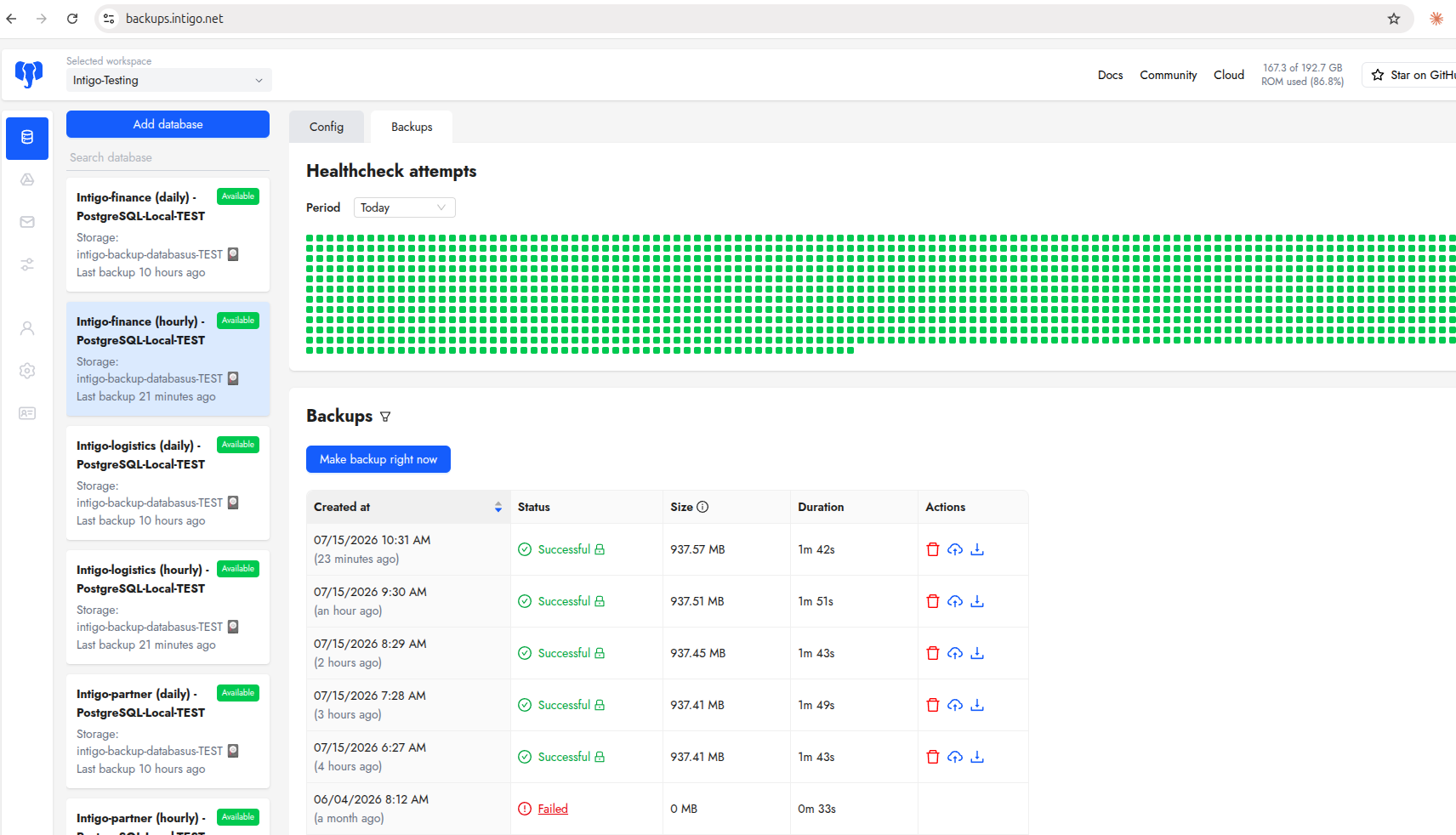
One of my first big responsibilities was making sure IntiGo's data could never be lost. I designed and deployed a complete automated database backup strategy built on Databasus, self-hosted on GoDaddy cloud servers behind an Nginx reverse proxy at a dedicated internal subdomain (backups.intigo.net).
The system covers 6 database targets — finance, logistics, and partner databases, each with both daily and hourly schedules — pushing to the intigo-backup-databasus storage bucket. Every backup — success or failure — pushes an instant notification to a dedicated Slack channel and by email, and a healthcheck grid on the dashboard makes green/red status readable at a glance. What used to be a fragile manual process became a hands-off, observable system.
A Shopify app that pushes orders straight into our system
Merchant partners on Shopify needed a frictionless way to hand their orders to IntiGo for delivery. I built a Shopify integration app that sends new orders directly into our system the moment they are placed — no manual export, no copy-paste.
From inside their Shopify Admin, merchants can push orders and track shipment status natively, so the handoff between their store and our delivery network is completely automated.
A WooCommerce plugin for the same goal
Many of our partners run on WordPress / WooCommerce instead of Shopify. To serve them, I developed a custom PHP plugin that connects their WooCommerce store directly to IntiGo’s delivery API.
The plugin forwards every new order to our system automatically — giving WooCommerce merchants the exact same zero-friction order handoff that Shopify merchants get.
A PrestaShop module — one codebase, every version
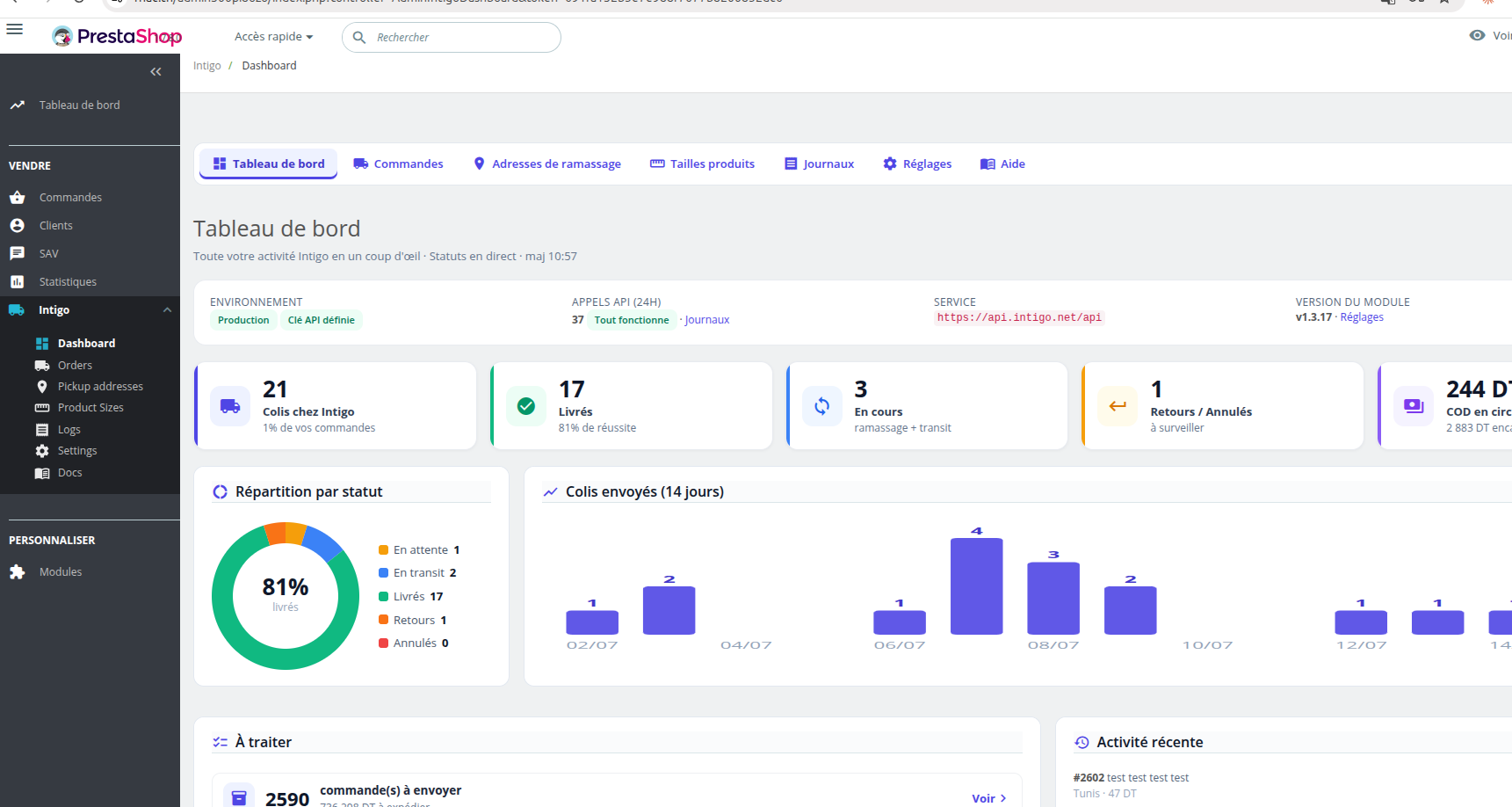
To round out the e-commerce coverage, I shipped a PrestaShop module (launched June 4th, 2026) that gives PrestaShop merchants the same zero-friction order handoff to IntiGo. A single codebase runs across PrestaShop 1.7.x, 8.x and 9.x on PHP 7.2+ — validated end-to-end on the client target 1.7.8.11 / PHP 7.4.33, plus 8.1 and 9.1.3.
It registers an Intigo carrier with size-based shipping pricing (S/M/L/XL resolved per product), a French-first back office in the Intigo brand — dashboard, orders screen with one-click push and bordereau generation, per-product sizes and status sync. It is hardened for production: it never breaks a core admin page, preserves the API key and order↔parcel links across reinstalls, and ships as a versioned GitHub release clients can self-install.
E-commerce: turnkey storefronts for our shippers
Beyond delivery, we wanted our shippers (expéditeurs) to be able to sell — not just ship. So I started building a full e-commerce offering: we create complete online stores for our shippers and help them sell their products directly to their customers.
Each storefront comes with a coupons and promotions system, full inventory and stock management, product catalogs, and order handling — and because it is wired into IntiGo, every order placed on the store flows straight into our delivery network automatically.
The goal is a single, end-to-end loop for a shipper: list a product, run a promo, sell it, and have IntiGo deliver it — all from one connected system.
4 iOS apps + 1 Android — the IntiGo mobile product family
The mobile surface grew into a full product family — I built and shipped 4 iOS apps and 1 Android app on the same CI/CD foundation, all in React Native with a FastAPI backend.
On iOS: Intigo Mobile 2.0.0 (end-customer parcel tracking, Ready for Distribution), BizGo for Partners 2.0.0 (merchant-side, Ready for Distribution), EnaGo 2.0.0 (Ready for Distribution), and Livraison.pro 1.0 (currently in Apple Review). On Android: Intigo Mobile is live on the Google Play Store alongside its iOS twin.
One team, one pipeline: GitHub Actions builds, signs, and ships each app through App Review or Play Console automatically — every release is one merge.
 Intigo Mobile
 BizGo for Partners
 EnaGo
 Livraison.pro
Keeping the core running
Alongside the new work, I maintained and debugged the legacy systems built on Django and PostgreSQL that power IntiGo's day-to-day operations — making sure the platform processing 10M+ parcels stayed stable while we modernized around it.